Starvard University · Machine Learning
What machine learning actually is, minus the hype. How models learn from data, what they are good at, where they fail, and how to start using them today.

The whole course in brief
The twelve lessons
Lesson 1
Traditional software is a recipe. A programmer writes exact steps: if the customer spent more than $100, give them free shipping. The computer follows the recipe perfectly and learns nothing. Machine learning flips this. Instead of writing the rules, you show the computer thousands of examples and let it figure out the rules itself.
Think of teaching a kid to recognize dogs. You do not hand them a rulebook about snouts and tail angles. You point at dogs and say "dog" enough times until they get it. Machine learning is that, with math. Feed a model ten thousand labeled pictures and it builds its own internal notion of "dogness" that works on pictures it has never seen.
This is why ML exploded in the last decade. We finally had two things at once: mountains of labeled data from the internet, and computers fast enough to chew through it. The ideas are mostly old. The scale is new.
Lesson 2
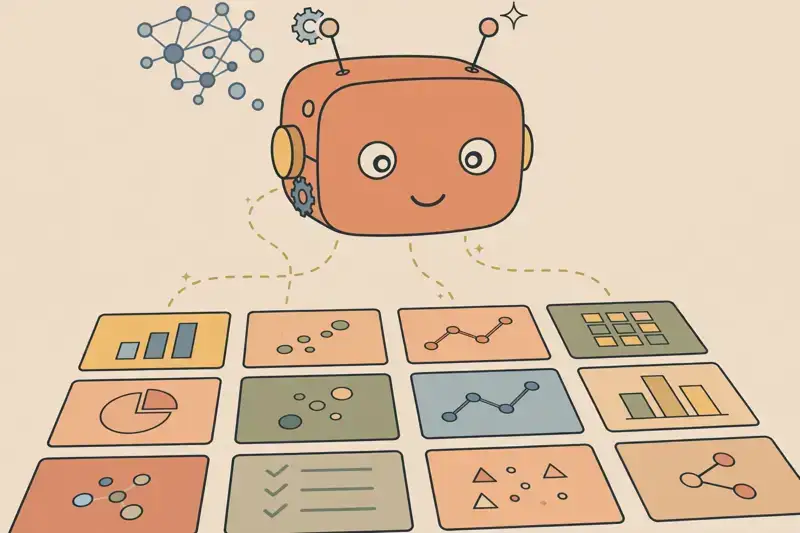
The most common kind of machine learning is called supervised learning, and it runs on labeled examples. Spam filters learn from millions of emails humans marked "spam" or "not spam." Credit card fraud detection learns from millions of transactions marked "fraud" or "legit." The label is the teacher.
Here is the loop: the model makes a guess, checks how wrong it was, and adjusts itself to be a little less wrong next time. Repeat millions of times. That adjustment process has a fancy name, gradient descent, but the idea is simple: guess, measure the error, nudge, repeat. Eventually the nudges add up to something that guesses well.
This also tells you where ML projects fail. If your labels are wrong, sloppy, or biased, the model learns wrong, sloppy, biased patterns. A hiring model trained on a decade of a company's biased hiring decisions will learn to be biased. The machine does not know better. It only knows the examples.
Lesson 3
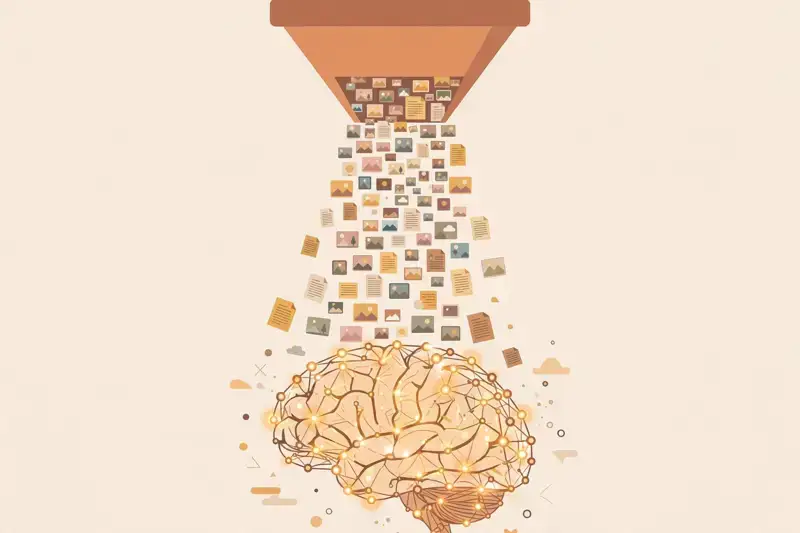
Every ML breakthrough of the last fifteen years was, underneath, a data breakthrough. Image recognition took off when researchers got a million labeled photos. Language models took off when they could train on most of the public internet. The algorithms matter, but data is the fuel and the engine both.
This is why big companies have a structural advantage. Google does not just have better researchers; it has billions of searches, emails, and photos to train on. Data is the moat. It is also why "we have an AI strategy" means nothing without "we have a data strategy" underneath it.
For you, the practical lesson is smaller and more useful: any ML project starts with the question "do we have enough good examples?" If the answer is no, stop. Collect data first. The fanciest model in the world cannot learn a pattern from forty examples.
Lesson 4
Some problems are clean enough for hand-written rules. Tax software is rules. A chess engine from 1997 was mostly rules and search. But some problems are too messy for rules: recognizing faces, understanding speech, translating slang, flagging fraud that keeps changing shape. Nobody can write the rulebook for "what does a fraudulent transaction look like" because the answer has ten thousand exceptions.
That messiness is exactly where learning from examples wins. A fraud model does not need a rulebook. It needs a million examples of fraud and a million of legit, and it finds the patterns humans would never spot: the time of day, the merchant category, the velocity of purchases, combinations no analyst would think to check.
The flip side: if a problem is simple and stable, do not use ML. A spreadsheet formula beats a neural network for calculating shipping costs. ML is a power tool for messy pattern problems, not a replacement for arithmetic. Using it where rules suffice is the most common beginner mistake.
Lesson 5
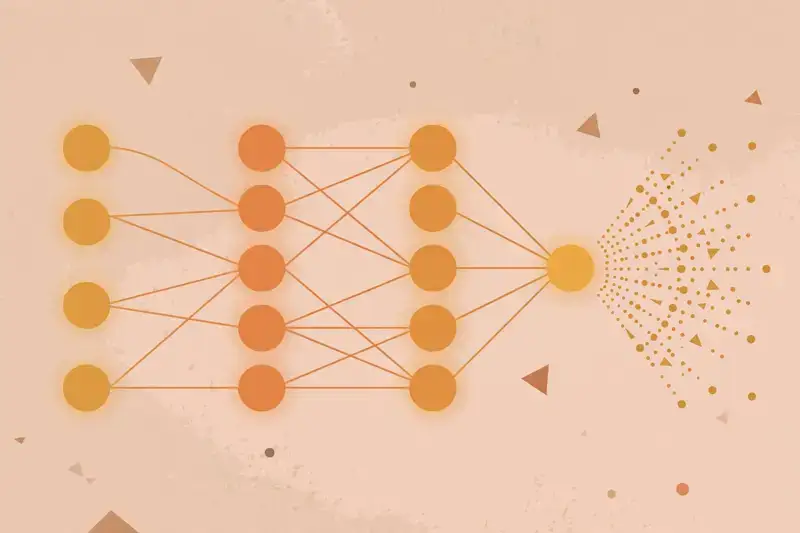
A neural network is layers of tiny decision-makers stacked together. Each little unit takes some numbers in, does simple math, and passes a number on. One unit alone is dumb. Millions of them, arranged in layers, with each layer's output feeding the next, can learn to recognize a cat, transcribe speech, or translate French.
The magic word is "layers." Early layers learn simple stuff: edges, corners, basic sounds. Later layers combine those into complex stuff: eyes, wheels, words. This hierarchy is why deep networks (many layers) beat shallow ones. Each layer builds on the last, like an assembly line for understanding.
"Training" a neural network means adjusting the strength of every connection between units, all millions of them, so the final output matches the right answer more often. It is glorified trial and error at inhuman scale. Nobody programs in what a cat looks like. The network discovers it, layer by layer, from the data.
Lesson 6
A large language model does one thing: predict the next word. Given "The cat sat on the," it guesses "mat" is likely. That sounds trivial until you realize that predicting the next word really well, across every topic, requires something like understanding. To finish sentences about physics, jokes, code, and history, the model had to absorb physics, jokes, code, and history.
Scale is the whole story. Train that next-word prediction on most of the internet's text, with billions of adjustable connections, and the model starts doing things nobody explicitly taught it: translating, summarizing, writing code, answering questions, reasoning step by step. Researchers call these "emergent abilities." They showed up uninvited once models got big enough.
This is also why language models sometimes make things up. They are not databases looking up facts. They are prediction engines generating the most plausible continuation. Plausible is not the same as true. Treat them as brilliant interns: fast, knowledgeable, and in need of checking.
Lesson 7
A student who memorizes last year's exam aces last year's exam and fails this year's. A model can do the same thing. If you train it too long on too little data, it stops learning the pattern and starts memorizing the specific examples, noise and all. On training data it looks perfect. On new data it falls apart. That is overfitting.
The defense is simple in concept: always test on data the model has never seen. Split your examples into a training set and a test set, and judge the model only on the test set. If training accuracy is 99% and test accuracy is 60%, your model memorized. It learned nothing useful.
This idea generalizes beyond ML. Anytime someone shows you a model, a strategy, or a backtest that looks perfect on past data, ask: "how does it do on data it has never seen?" Past performance with no out-of-sample test is a story, not evidence.
Lesson 8
ML finds correlations, not causes. A model might learn that people who buy premium dog food default on loans less often. That does not mean dog food causes repayment. Models do not understand why, and when the world changes, the correlation can break overnight. Every ML system needs someone watching for the moment reality shifts under it.
ML also has no common sense and no values. It will happily optimize exactly what you told it to optimize, including the parts you did not mean. Tell a model to maximize watch time and it will promote outrage, because outrage keeps people watching. The failure is not in the math. It is in the goal.
Finally, ML cannot create data it does not have. It cannot predict a truly unprecedented event, it cannot reason about things absent from its training, and it cannot tell you when it is out of its depth. Knowing these limits is what separates people who use ML well from people who get burned by it.
Lesson 9
Strip away the hype and ML is already doing quiet, valuable work everywhere. Recommendations: what to watch, what to buy, what to listen to. Search: ranking results, understanding typos, answering questions directly. Fraud: banks decline suspicious charges in milliseconds. Logistics: routing packages, predicting demand, managing inventory. Medicine: flagging anomalies in scans for radiologists to review.
Notice the pattern. These are all prediction problems with tons of data and clear feedback. Did the customer click? Was the charge fraud? The model gets told quickly whether it was right, so it keeps improving. ML thrives where the feedback loop is fast and the data is plentiful.
That pattern is also a career hint. The valuable skill is not "knowing ML algorithms" in the abstract. It is finding a messy prediction problem inside a real business, getting the data, and wiring a model into a decision. Domain plus data plus deployment beats theory every time.
Lesson 10
Every few years the industry declares that AI will replace everyone, and every few years the reality is narrower and more useful than the promise. The pattern to watch: demos are easy, deployment is hard. A model that writes a beautiful poem in a demo may still fail at your company's invoicing workflow, because your workflow has edge cases no demo shows.
Here is a practical hype filter. Ask three questions. One: does it work on my data, not the demo data? Two: what does it cost per decision, including the mistakes? Three: who is accountable when it is wrong? Products that answer all three clearly are usually real. Products that wave at the future usually are not.
The hype also creates opportunity. When everyone chases the shiny thing, the unglamorous work, cleaning data, wiring integrations, measuring results, becomes the scarce skill. Be the person who ships working systems while others argue about the singularity.
Lesson 11
There are three doors into ML work. Data analyst: you work with data, build dashboards, answer questions with numbers. This is the most accessible door and every company needs it. Machine learning engineer: you build and deploy models into products. Data scientist: you sit between the two, modeling and experimenting. All three start in the same place: being good with data.
The honest curriculum: first get comfortable with spreadsheets, then SQL (the language of databases), then Python with its data libraries. Build small projects with real datasets, the kind you can find free online. Employers hire for demonstrated work, not certificates. A GitHub page with three solid projects beats a wall of course completions.
You do not need a PhD. Most working ML engineers are not researchers. They are builders who learned enough math to be dangerous and enough engineering to ship. Start with the data skills from lesson 3's world, add one ML course with real projects, and you are employable faster than the degree programs admit.
Lesson 12
Here is a project you can finish this weekend with zero background. Pick a dataset you care about: your city's housing prices, a sports stat you follow, movie ratings. Free datasets are everywhere. Load it into a free notebook environment, and build the simplest possible model that predicts one column from the others.
Your goal is not accuracy. Your goal is the full loop: get data, clean it, train a model, test it on unseen data, and write up what you learned. That loop is the job. Every professional ML engineer runs it daily. Doing it once, end to end, teaches more than ten tutorials.
Then do it again with a twist: try a different algorithm, add a new data source, or predict something harder. Three loops like this and you will understand machine learning better than most people who talk about it online. The field rewards builders. Go build.
Graduation
Machine learning is pattern finding at scale: examples in, predictions out, tested on data it has never seen. It is brilliant at messy prediction problems and useless without good data. The hype will keep shouting, but the real work is quiet: clean data, clear goals, honest testing. You now know enough to see through the noise and start building.
Keep learning
This course is part of Starvard University, striving for greatness.
A note on accuracy: Much of what you read at Starvard was created with help from AI agents, working alongside people. We check what we can, but we cannot guarantee that everything here is true, current, or complete. If something really matters, your health, your money, a grade, a job, please verify it with a trusted source before you rely on it.